

Updated Sep 10, 2026 ↓
Most Americans agree that billionaires’ taxes are too low, and what’s more, they’re bothered by it. Public support for taxing the rich has helped put a billionaire tax on the ballot in California this November, and has spurred campaigns by past and future presidential hopefuls including Elizabeth Warren, Gavin Newsom, Bernie Sanders and Ro Khanna to pass a wealth tax nationally. Proposals by various politicians and advocates vary, but the core idea is that there needs to be a tax pegged to wealth, rather than income, in order to make millionaires and billionaires pay their fair share.
But if there’s political will to make millionaires and billionaires pay more, is a wealth tax the best way to go about it?
Let’s put it under review.
How are the ultra-rich taxed?
Since wealth generates income via interest, dividends and capital gains, the ultra-rich often have both staggering fortunes and eye-popping earnings. But for tax purposes, only income matters under the status quo. The question of how to tax the ultra-rich largely hinges on whether wealth or income is a better tax base, and how each concept should be measured.
Wealth is the total value of a person’s assets, minus their liabilities, at a point in time. For most people, wealth is fairly simple to measure—their assets include cash savings, retirement or other investment accounts, and residential real estate, all of which have observable market values. For the ultra-rich, though, measuring wealth is complicated. Many of their assets—such as shares in private companies, art and large real estate holdings—have volatile prices and are fairly illiquid, which means sales histories are thin. Most researchers rely on tax records and survey data to estimate the wealth of the top 0.1% of the wealth distribution, and on data collected by Forbes for insight into the assets of an even more exclusive subset: the 400 richest Americans. According to these data, a household needed to have a net worth of about $46 million to be in the top 0.1% in 2022, while the cutoff for the Forbes 400 was about $2.7 billion.
Income refers to the flow of value a person receives over a period of time, or a change in wealth. But economists prefer to measure income differently than the IRS:
Economic income treats changes in asset values as income right away. Formally, it’s equal to the change in a person’s net worth plus their consumption over a period of time.
Taxable income is defined more narrowly as realized economic gains, like cash received via wages or from the sale of an asset.
For example, if a shareholder’s portfolio increases in value from $1 to $10 over a year and they hold on to their shares, they have $9 in economic income but no taxable income. If they sell their shares, they have $9 in income by either measure.
Economic and taxable income usually look similar for people who earn their living from paychecks, but the measures diverge for people who are rich enough to own substantial asset portfolios. The 0.1% earn about $2-3 million of taxable income per year on average, but their economic income is much higher, because about half of the increase in their net worth in any given year comes via unrealized capital gains. For example, from 2014–2018, Warren Buffett reported about $125 million in taxable income while his net worth rose by an estimated $24.3 billion.1
The U.S. income tax system is designed to be progressive by taxable income, not economic income. For about 99.9% of the population, it is: people with more taxable income pay a higher share in tax. But progressivity appears to break down at the very top. As a share of taxable income, the Forbes 400 pay less than they should. As a share of economic income, tax rates begin to drop off at a lower threshold, around the top 0.1%.2
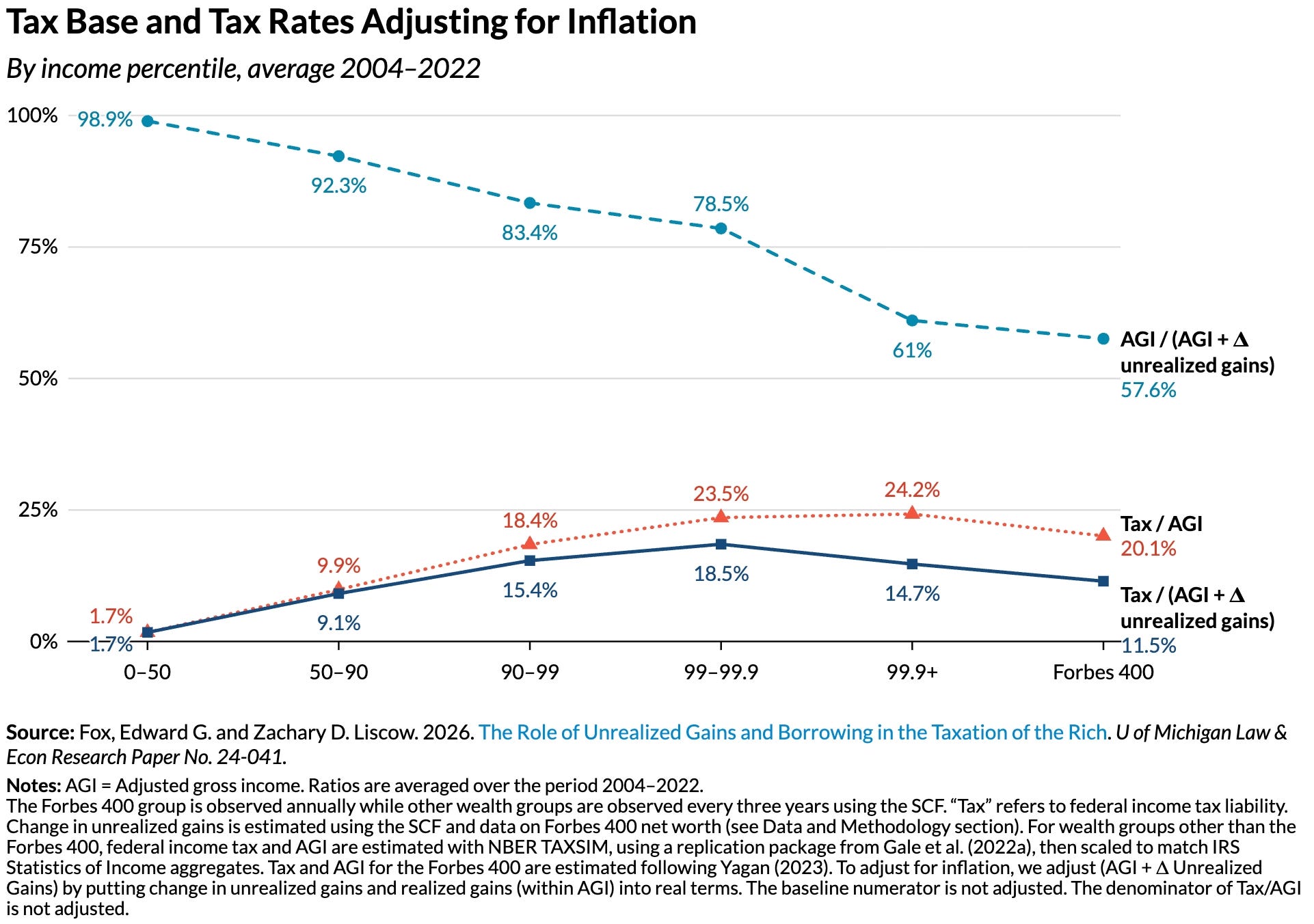
What’s the case for a wealth tax?
The defining feature of a wealth tax is that it pegs someone’s tax liability to their net worth at a point in time, rather than their income over a period of time. The rationale for most current wealth tax proposals is that the wealth of the ultra-rich is a better indicator of their ability to pay than their income, especially given the rules around what income counts as taxable.
As Sen. Elizabeth Warren puts it:
“Consider two people: an heir with $500 million in yachts, jewelry, and fine art, and a teacher with no savings in the bank. If both the heir and the teacher bring home $50,000 in labor income next year, they would pay the same amount in federal taxes, despite their vastly different circumstances.”
Details such as eligibility thresholds and tax rates vary across wealth tax proposals. For example, the “billionaire tax” on the ballot in California would impose a one-time 5% tax on assets over $1 billion, while Warren’s “ultra-millionaire tax” would levy a 2 or 3% tax annually on assets over $50 million and $1 billion, respectively. Economist Gabriel Zucman has proposed that those with at least $1 billion pay a minimum of 2% of their total net worth in tax each year, inclusive of existing income taxes.
At the rates proposed, wealth taxes are designed to slow the rate of millionaires’ and billionaires’ wealth accumulation—not to deplete their wealth relative to current levels. In order to deplete wealth, tax rates would need to be higher than the rate of return, which Zucman estimates to be 7.5% for the 0.1% and 11.3% for the Forbes 400, on average.
Does the case for a wealth tax hold up?
The tax system isn’t progressive at the very top, but a wealth tax isn’t the best way to fix it. Economic income is a better proxy for ability to pay than static net worth, and can be taxed effectively by tightening capital gains tax rules and raising rates.
Economic income is a better measure of ability to pay than wealth
Taxable income is a poor proxy for ability to pay. An heir with $500 million in assets can obviously afford to pay more tax than the typical school teacher even if they have the same taxable income in any given year. But static net worth is also a poor proxy for how much tax someone can afford. If the heir decides to spend lavishly instead of saving their millions, their consumption choices will lower their net worth, but that shouldn’t lower their tax bill.
The concept of economic income addresses this problem by capturing changes in both net worth and consumption. Anyone who receives $500 million in a given year has $500 million in economic income regardless of whether they receive cash or assets, and regardless of whether they save, spend or reinvest the money. Economic income recognizes that non-cash assets are real financial resources, and that income spent on consumption could otherwise be spent on taxes.
If economic income is a better proxy for ability to pay than cash receipts or static net worth, then the tax system should aim for progressivity by that metric. But wealth taxes aren’t designed to achieve it.
Imagine two people who start the year with $500 million in cash and will be subject to a 2% wealth tax at the end of the year.
The first invests the cash and earns a 2% return, which is entirely eaten up by the wealth tax. Their effective tax rate by economic income works out to about 102%, and they finish the year almost exactly where they started.
The second earns a higher return, 5%, which the wealth tax takes a bite out of. Their effective tax rate by economic income is only about 42%, and they finish the year with $14.5 million more than they started.
Wealth taxes put the most drag on wealth accumulation for savers and investors with the lowest returns, and the least drag on investors earning the most, who also tend to be the wealthiest. The fact that wealth taxes penalize low-return investments relative to high-return investments could be considered a virtue, since it could encourage more productive capital allocation.3 But if the goal is to make taxes track ability to pay, then wealth taxes aren’t a precise treatment. Since wealth taxes are pegged to levels of wealth, rather than changes in wealth, they aren’t designed to be progressive by economic income.
Taxing economic income annually is impractical and risks negative spillovers
If we want to achieve progressivity by economic income, then taxing all capital gains directly, as they accrue, seems like an obvious move. Mark-to-market capital gains taxes are designed to do just that, and have been proposed at the federal level as an alternative to wealth taxes. Whereas wealth taxes would be levied on a person’s net worth on December 31, mark-to-market taxes would target annual changes in net worth by taxing capital gains whether or not they’re realized. Plus, since they tax gains as they accrue, mark-to-market taxes can’t be minimized via consumption.
However, taxing unrealized gains is liable to create more problems than it solves.
Many assets are hard to value, especially those that don’t change hands often. To administer a recurring mark-to-market or wealth tax on unrealized gains, assets would need to be valued at least every year. But without transactions observed by a third party, owners and tax assessors have to speculate about what a buyer would pay for each asset, and whenever prices are contested, administrative costs deplete revenue. Valuation is less of an issue for shares in public companies, but taxing unrealized gains could incentivize shareholders to keep companies private.
Even if asset values were transparent and up-to-date, they can be volatile. Any snapshot measure of an asset’s worth can therefore be outdated by the time payment is due. For example, startup valuations often skyrocket or plummet around make-or-break events, so investors’ tax burdens would be very sensitive to timing. In other cases, asset owners might intentionally manipulate asset prices ahead of tax day. There’s consistent evidence from Colombia, Spain, Sweden and Switzerland, for example, that wealth taxes cause households to declare less wealth.4
And even if assets experience steady and predictable changes in value over time, some are illiquid. Shares in private companies, for example, aren’t traded on a public market and are often legally restricted. To the extent that annual taxes on asset values force some taxpayers to liquidate assets to pay their bills, that could cause economic distortions downstream, like disinvestment in startups or capital misallocation more broadly.
Closing capital gains tax loopholes and raising rates can achieve progressivity by economic income over time
It would be legally and administratively difficult to tax unrealized gains on an annual basis, and it could do economic damage. Yet as it stands, capital gains can escape the tax base permanently. Some common-sense reforms to capital gains taxes would significantly improve on the status quo and move the tax system toward progressivity by economic income over time.
The biggest escape hatch for capital gains is the step-up in basis rule, also known as “the angel of death” loophole. When shareholders die, any unrealized capital gains that have accrued on their assets are wiped out for tax purposes. To return to Warren Buffett: if he were to die before selling his appreciated shares, the $24.3 billion in gains would never be taxed as income, even if his heirs eventually realized them.5 This loophole doesn’t just impact taxes at death; by creating an incentive for shareholders to defer realization, it widens the gap between taxable and economic income during life.
The ultra-rich can also donate appreciated assets to charity, which nets them a double tax benefit: they can deduct the fair market value of the donation from their taxable income and avoid paying taxes on the associated capital gains.
Moreover, even when capital gains are realized and taxed, the rate schedule isn’t designed to be progressive at the top. The highest marginal tax bracket for capital gains currently kicks in at $600,050 for married taxpayers filing jointly. However, members of the 0.1% earn multiples of that. If all capital gains were realized and taxed as income in the year they accrued, the first dollar earned over $600,050 would be taxed at the same rate as the billionth.6
In her wealth tax pitch, Elizabeth Warren argues that “while we must make income taxes more progressive, that alone won’t straighten out our slanted tax code or our lopsided economy.” But Warren’s proposal, like all others on the table, would tax wealth at a rate that is lower than the average rate of return for the ultra-rich; it’s meant to slow the growth of top fortunes, not deplete them. That’s exactly what higher capital gains tax rates are designed to achieve, and they can do it more simply and precisely.7
What should we do?
To achieve progressivity by economic income on an annual basis, we’d have to tax unrealized capital gains. We aren’t convinced that’s feasible or desirable. But there’s a pretty straightforward way to make taxes on realized, cash income progressive each year: make the capital gains tax schedule steeper. With new tax brackets for people who earn millions or billions in capital gains, policymakers could adjust rates in a targeted way to slow the rate of wealth accumulation at the very top of the distribution. Several U.S. states—including California, Maine, Massachusetts, Minnesota, Rhode Island and Washington—have recently implemented this type of “millionaire tax,” using new tax brackets or surtaxes to raise effective tax rates on top earners. Taking a similar approach at the federal level would reduce flight risk and have a broader impact.
Over a longer time horizon, we can move toward progressivity by economic income by ensuring that all capital gains are realized—and taxed—during an asset holder’s life or at the time of their death. Replacing the stepped-up basis rule with a rule that treats all capital gains as realized at death or upon transfer to heirs would raise about $460 billion over five years. Taxable income could still lag changes in net worth in any given year, but reducing the incentive to hold assets until death should encourage earlier realizations, which would pull tax revenue forward.8
Eliminating or continuing to shrink the charitable deduction for high earners is also a strong candidate for increasing progressivity. In 2025, the charitable deduction cost about $72 billion in foregone federal tax revenue, and about 92% of the benefit went to taxpayers in the highest income bracket. In addition to raising normative concerns, these tax expenditures are inefficient: a 1% increase in the subsidy for the ultra-rich to contribute to their family foundations, for example, led to only a 0.67% increase in contributions and a 0.33% increase in actual charitable disbursements. Similar loopholes that need to be closed include rules that allow gains to accrue tax-free in certain trusts and private life insurance policies.
Even if all these steps are taken, some proponents of wealth taxes would undoubtedly like to go further and take steps to limit extreme wealth in absolute terms, rather than merely slowing its growth. If there’s political will to deplete large fortunes via taxes, then inheritance taxes—which we previously put under review—are a good option. Since they’re a one-off tax and affect heirs, rather than earners, they’re easier to administer and carry less risk of negative economic consequences than high wealth taxes. Plus, they already have support among some of the most vocal supporters of wealth taxes.
Finally, we need to caveat that taxes are only one side of a tax and transfer system. In theory, even a highly progressive tax code by any measure can be undone with regressive spending patterns; and inversely, progressive spending can offset regressive taxes. While we favor a tax code that’s fair on its own terms, we recognize that redistribution via spending is also important, and will put ideas on that side of the ledger under review, too.
Notes
Buffett isn’t an outlier in terms of his tax rate, but he is notable among billionaires for calling for higher taxes on the rich.
Estimates of top tax rates vary depending on researchers’ methodological choices, but even the most charitable take on the status quo indicates that tax rates are essentially flat at the very top (Splinter 2025), which is inconsistent with progressivity.
Higher rates of return don’t necessarily reflect productivity and can instead come from windfalls, rents, or inside information (Scheuer and Slemrod 2021).
Wealth tax proposals usually have high eligibility thresholds before any tax applies—$50 million in Warren’s proposal, or $1 billion in Sanders’, Zucman’s and California’s Prop 40. In part, that’s because at lower wealth levels the costs of valuation and enforcement outweigh revenue potential. But while high eligibility thresholds can help limit administrative costs, discrete cutoffs encourage manipulation of asset values. They also undermine the argument for wealth taxes as a way of pegging tax burdens to ability to pay: if an heir with $500 million in assets can afford to pay more tax than a teacher with no savings, by the same logic so can someone with $500,000 in savings. These issues are largely avoided by taxing capital gains at realization, since market values can be observed and tax rates are indifferent to savings and consumption decisions.
The $24.3 billion will be subject to a 40% estate tax, although there are many ways to avoid paying. Even a fully binding estate tax wouldn't be a substitute for income taxes during life, though. Estate taxes can be understood as a substitute for inheritance taxes, but the latter are a better way of taxing intergenerational transfers.
Top statutory tax rates on capital gains (23.8%) are lower than top rates on ordinary income (37%), which means that, all else equal, a shareholder would pay lower income taxes than a worker with the same income. However, statutory capital gains tax rates understate the total tax burden borne by the 0.1%, since corporate taxes take a bite out of capital gains before they reach shareholders. Economists debate exactly how much of the incidence of corporate taxes falls on shareholders vs. employees, but tend to agree it’s tilted toward shareholders and makes up most of the tax burden of the top 0.1% (Auten and Splinter 2024). Even if there is a capital gains tax preference, though, it can’t explain why effective tax rates are flat or regressive at the very top of the distribution (Balkir et al. 2025, Splinter 2025), where most income is generated from capital gains.
A wealth tax t is revenue-equivalent to a capital income tax τ = (1+r)t/r imposed on capital income rW, where r is the rate of return and W is the stock of wealth (Kopczuk 2019). Counterintuitively, the higher the rate of return, the lower the capital gains tax rate needs to be to approximate a given wealth tax. For example, a capital gains tax of 28.7% is equivalent to a 2% wealth tax on assets generating 7.5% returns, while for 11.3% returns the equivalent tax rate is 19.7%.
If the step-up in basis rule is repealed without constructive realization at death or transfer, the effect on both realizations and tax revenue will be more muted, as in Norway (Msall and Næss 2026). Shareholders may still have an incentive to hold on to assets indefinitely in hopes that the policy will eventually be reversed (Rosenthal and McClelland 2025). Some experts would take further steps to reduce the deferral advantage. For example, retrospective taxation would charge interest on top of whatever taxes are due on realized gains based on how long realization was deferred (see Auerbach 1991 for the canonical version of this idea). Other proposals would tax capital gains at death at a rate higher than during life (Rosenthal and McClelland 2025). Either proposal could complement reforms that bring more capital gains into the tax base, but would have drawbacks that warrant further review.
Update log
Sep 10, 2026
Added footnote 5 to clarify how unrealized capital gains are taxed at death.