Policymakers at the federal, state and local level use a variety of policy levers—including tax, spending, credit and planning rules—to steer households toward owner-occupancy.
For new buyers, down payment assistance programs offer grants, forgivable loans or low-cost secondary loans to help cover mortgage deposits and closing costs. There are about 2,500 different down payment assistance programs offered by over 1,300 state and local agencies and nonprofits.
Existing homeowners, meanwhile, benefit from several tax breaks. They can deduct mortgage interest payments and some local property tax payments from their federal tax bill, although in practice these deductions are only used by high-income tax filers in expensive housing markets. They don’t pay income tax on “imputed rent” (that is, the “rent” owner-occupants effectively pay to themselves, as their own landlord), and when they sell their home most capital gains are exempt from federal tax. At the state and local level, long-term homeowners often benefit from tax assessments that are significantly lower than their property’s market value.
Government policies have also made it possible for more people to borrow more money to spend on homeownership. Fannie Mae and Freddie Mac—collectively known as “the GSEs” or government-sponsored enterprises—have increased the supply of credit for prospective homeowners by securitizing mortgages, which reduces lenders’ risk and improves their liquidity. The government is no longer actively subsidizing Fannie and Freddie, but the consensus is that without government backing for GSE loans, borrowing costs would increase and homeownership rates would fall.1
Finally, many local jurisdictions implicitly favor homeownership by making it hard to build multifamily housing and hard to rent single-family housing. While housing form and tenure aren’t inherently linked—single-family homes can be rentals, and units in multifamily buildings can be owner-occupied—they’re strongly correlated. Large swathes of the U.S. have zoning rules that only allow single-family homes, and there have been proposalsinCongressandseveralstatelegislatures to restrict the conversion of single-family homes from owner-occupancy to rentals.
It’s hard to estimate state and local spending on down payment assistance and tax breaks, given policy fragmentation and variable uptake, and while credit and planning rules incentivize homeownership they don’t explicitly subsidize it. At the federal level though, the mortgage interest deduction, local property tax deduction, capital gains exclusion and non-taxation of imputed rent cost the federal government about $254 billion in 2025, according to the U.S. Treasury.
All told, U.S. policymakers spend an awful lot of time and money promoting homeownership, which might be better spent elsewhere.
It’s time to put homeownership under review.
Why does the U.S. promote homeownership?
There are three rationales that, if true, could justify government efforts to promote homeownership. As recapped by a 2019 Congressional Research Service report:
Homeownership could have financial benefits for households. It could help people build wealth via the forced savings mechanism of paying off a mortgage, via an investment return from house price appreciation or, more indirectly, by causing better educational and employment outcomes.
Homeownership could have non-financial benefits for households. In theory, ownership might give people a greater sense of control over their environment or confer greater psychological security than renting, all else equal, which could improve their overall health and well-being.
Homeownership could have positive spillovers for communities. For example, it might cause people to become better custodians of their property and of nearby public spaces, or to become more involved in their neighborhood’s social and political life.
Does the case for homeownership hold up?
No. While homeownership can help households build wealth in certain cases, it’s a risky investment strategy and any payoff comes at the expense of renters and future buyers. Moreover, homeownership doesn’t have any clear positive spillovers on net. There’s no compelling justification for policies that favor homeownership over renting.
Homeownership is risky and zero-sum
Buying a house is a risky investment strategy.
The main channel for building wealth via homeownership is price appreciation: if owners can buy low and sell high, then they can earn a positive ROI. But even when average house price appreciation is high, individual owners don’t always come out ahead.2 Returns are very sensitive to location and market timing, and gains from appreciation are offset by rising property tax, insurance and maintenance costs.
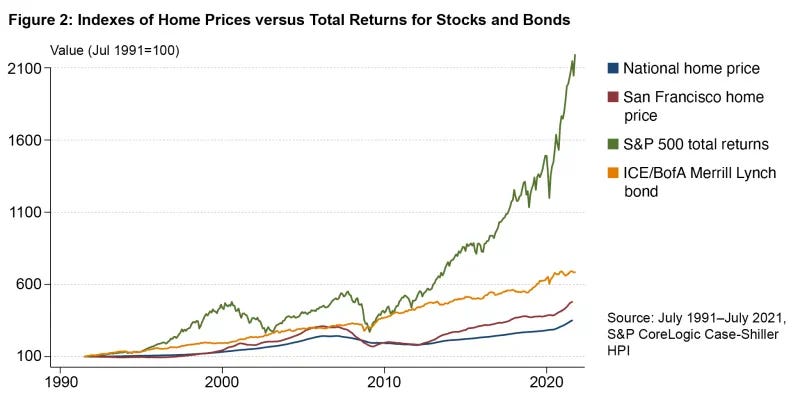
In many cases, owners could get an equivalent or higher financial return, with lower risk and higher liquidity, by investing in a portfolio of stocks and bonds.
Even in San Francisco, the home price index has grown less than has a broad mix of investment-grade corporate bonds and far less than the S&P 500. A plan for building long-run wealth should harness the growth potential of the full market.
Steering households to invest in homeownership exposes them to serious downside risk, especially if they don’t have other assets to fall back on. As Jenny Schuetz writes:
One of the principles of financial advice is to invest in a diversified portfolio, spreading savings across a range of industries and firms (for example, through mutual funds rather than individual stocks) reduces the risk of large losses. Buying a home is the opposite of diversification. For families without large amounts of wealth, homeownership concentrates a family’s resources in a single physical asset, industry, and location.
Worse, even when homeownership pays off for individual households, their gain comes at the expense of renters or would-be buyers who are then priced out of the market.
At the core of American housing policy is a secret hiding in plain sight: Homeownership works for some because it cannot work for all. If we want to make housing affordable for everyone, then it needs to be cheap and widely available. And if we want that housing to act as a wealth-building vehicle, home values have to increase significantly over time. How do we ensure that housing is both appreciating in value for homeowners but cheap enough for all would-be homeowners to buy in? We can’t.
Affordability for new buyers and wealth building for incumbents are conflicting goals. Faced with a choice between them, policymakers have tried to have their cake and eat it, too. But policies that supposedly improve affordability for first-time buyers have primarily increased the wealth of incumbent owners by propping up house prices.
Down payment assistance programs are designed to help new buyers overcome the upfront costs of homeownership, but since sellers are wise to the subsidies, they’re largely passed through to incumbent owners.3 If a state gives buyers a $10,000 subsidy, for instance, sellers will raise their listing price by about $10,000. As a result, these subsidies don’t meaningfully expand access to homeownership.4
Tax breaks on mortgage interest payments,5 local property taxes,6 home valuation increases7 and capital gains at the time of sale8 tend to raise house prices and increase owners’ real return for a given rate of price appreciation, which makes homeownership a better investment for incumbents but doesn’t improve affordability for newcomers.9
Finally, policies that expand access to credit, such as government guarantees for fixed-rate mortgages10 (with periodic conforming loan limit increases11) and deregulation of home equity loans,12 are meant to help buyers overcome borrowing and liquidity constraints. But by increasing buyers’ borrowing limits,13 these implicit subsidies again allow sellers to list for higher prices.
This approach is basically a Ponzi scheme: incumbent owners only get the return they were led to expect if policymakers continuously stimulate new investment via subsidies or credit expansion. The scheme could go on indefinitely if public spending or credit were limitless. But so long as there are spending caps and credit constraints, renters who aren’t already on the cusp of ownership (by virtue of high income or parental wealth, often in the form of home equity14) will be left holding the bag.
Homeownership doesn’t have clear positive spillovers for households or communities
While policymakers have long promoted homeownership as a way of creating strong families and communities, there’s no good evidence that it works. Buying a home doesn’t appear to make people better parents,15 neighbors16 or citizens,17 nor indeed healthier18 or more upwardly mobile.19 To the extent that homeownership is correlated with positive social outcomes, it’s probably driven by the fact that owners tend to have longer tenures—and thus more residential stability—than renters. In countries where the tenure gap is smaller, renters and owners look more similar across a range of individual and social metrics.
Homeownership does make people more likely to vote,20 but since that’s at least partly due to a desire to protect house values by blocking new construction it’s arguable whether it benefits society.21 It might also make people slightly less likely to commit property crimes, but the evidence is thin.22
Meanwhile, there’s clear evidence that under certain conditions homeownership can make it harder for people to move, which may have knock-on consequences for individual households and the broader economy. Homeowners with low or negative equity—a group that includes most new buyers, and many people in cool markets—often lack the cash to cover moving costs, and can therefore end up stuck in a house23 or place that no longer serves them.24 Homeowners with ample equity can end up locked-in,25 too, if interest rate rises mean that moving would increase their monthly costs.
Finally, policies that drive up house prices may inadvertently dampen aggregate economic growth if housing costs prevent workers from moving to productive cities,26 and/or if some homeowners make such a hefty return that they actually decide to work less.27
What should we do instead?
Buying a home is a reasonable choice for households to make. Policymakers shouldn’t be promoting owner-occupancy as a superior form of housing tenure though, much less as a superior way of building wealth. Instead, they should work to deliver housing and economic security via programs that are broadly accessible and positive-sum.
If the goal is to help families build wealth for their children or themselves, then promising options include baby bonds, automatic IRAs, or other tax-advantaged or subsidized savings schemes that pay modest but stable returns. These types of funds can give middle-income households a reasonable return on investment while offering more diversification and liquidity than homeownership. Better still, they aren’t zero sum: an incumbent investor’s gain doesn’t come at a future investor’s expense.
And if the goal is to create happier and healthier communities, then policymakers should focus on improving housing affordability, stability and quality for all households, regardless of whether they rent or own. Promising options here include subsidizing housing supply instead of demand, strengthening tenant protections, and reducing frictions that inhibit residential mobility so that households can choose to stay put or move as suits their needs. While financial and residential security are correlated with homeownership, they aren’t caused by it. Policymakers would be wise to make renting better rather than nudging all renters into ownership.
The government backs mortgages through several channels. One of them is through government-sponsored entities, such as Fannie Mae and Freddie Mac. The best available evidence suggests that increasing the conforming loan limit — which increases the size of loans that are eligible for such backing — has no discernible impact on homeownership on the margin (Grundl and Kim 2021). Instead, these limits seem to affect where households decide to buy (MacDonald 2019) and how much they borrow (Alexandrov et al 2024).
However, if these entities left government conservatorship altogether, guaranty fees would increase, which would likely cause mortgage credit supply to decrease (Amornsiripanitch and Ricks 2025). Homeownership would be estimated to decrease especially among lower-income and higher-credit-score households. The effect on lower-credit-score households is estimated to be more muted because many of those households tend to rely on FHA/VA loans instead, which are backed separately (Kim et al 2025).
Homeownership doesn’t necessarily increase household wealth. Whether buying a home has a positive or negative effect on a household’s net worth depends on the location of the home, the timing of purchase and eventual resale, and the individual household’s financial circumstances.
Homeowners can build wealth via two channels: via house price appreciation, and by effectively saving the money they would have otherwise spent on rent (Carroll & Cohen-Kristiansen 2021). These two positive inputs are offset by transaction costs that come with purchasing a home (i.e., closing costs, transfer taxes) and the ongoing costs of ownership (i.e., mortgage interest, property taxes, insurance and maintenance). Costs tend to offset rent savings such that owners mainly reap wealth gains when their house price appreciates between purchase and resale (Sodini et al 2023).
One study estimates the financial return from buying a home in 2002 with a 30-year fixed-rate mortgage and selling it in 2013, if the household optimally refinanced the mortgage when rates went down and took full advantage of the mortgage interest tax deduction, was a 12.3 percent annualized nominal rate of return (Goodman and Mayer 2018). However, individual rates of return are very sensitive to a home’s location and the timing of purchase and resale. Another study found that homeownership only leads to more wealth accumulation than renting in cities that have tightly regulated housing markets which drive up housing prices (Hilber and Turner 2024). Meanwhile, low-income households that purchased a home between 1989-1999 experienced substantial gains in wealth by 2011 compared to those that remained renters, but the advantage disappeared for those who first purchased a home from 2001-2007 (Wainer and Zabel 2020). Bringing the idiosyncrasies of time and location together, house prices in Cleveland and Chicago outpaced the national average during the 1990s while those in San Francisco lagged behind, but the opposite has been true since 2000 (Carroll & Cohen-Kristiansen 2021).
When owners move before prices appreciate enough to offset transaction costs, homeownership can lead to a negative return on investment. For example, a back-of-the-envelope calculation suggests that someone who purchases a median price home ($416,000), pays a 20% deposit, and has a 30-year mortgage with an average interest rate (7%) would need to own their home for about five years before breaking even with renting (Zillow). The “breakeven time” would go down if interest rates dropped and the owner took advantage of refinancing, or if house prices in their area rapidly appreciated, but the point stands that owners who sell quickly risk losing money on their investment.
Owners who stay put for longer periods are still at risk of a negative return if the value of their house flatlines or drops. When the value of a property stagnates, owners will fail to recoup ownership costs via appreciation and will therefore take a financial loss. If the price falls below the original purchase price (for example, due to a local or macro labor market shock) owners without mortgages are exposed to asset depreciation, and owners with mortgages can end up “underwater,” meaning their outstanding debt exceeds the value of the home itself. About 2% of U.S. mortgages were underwater as of Q3 2024 (CoreLogic), but the rate was about 25% after the 2008 financial crisis (Federal Reserve). If owners are forced to sell at a lower price than they bought at, or while in negative equity, they’ll lock in a negative return on investment.
In the worse case scenario, if owners are foreclosed on due to defaulting on mortgage, tax or insurance payments, they’ll likely take a significant financial loss. Homes that are foreclosed on are often sold at a discount (even in strong markets), which diminishes gains from appreciation. Even if there are equity gains, they’re usually claimed by lenders rather than going to the owner. Moreover, whatever equity owners had already sunk into the home (that is, payments on mortgage principal) are usually garnished as well to pay off debt and fees. Hundreds of thousands of homes in the U.S. are foreclosed every year and from 2008-2010 these figures topped 2 million per year (ATTOM).
All in all, homeownership is unlikely to increase any given household’s wealth in the short term and it’s hard to predict whether it will lead to net gains or losses in the medium to long term.
There is consistent evidence that first-time buyer subsidies drive up housing prices. In the US, the First-time Homebuyer Credit gave US households a one-time refundable tax credit to offset down payment and closing costs, in an effort to stimulate the economy after the Great Recession. The credit was worth 10 percent of the purchase price up to a maximum of $8000. One study estimates that a standard deviation increase in exposure to the stimulus (at the zip code level) was associated with a $2,400 increase in median house prices (Berger et al 2020).
Similarly, home purchase subsidies in Germany which were more narrowly targeted toward families increased house prices by almost the full subsidy amount (Krolage 2023). While the bulk of price increases are probably a straightforward pass-through, there’s suggestive evidence that credit-constrained households use subsidies to finance modest home improvements that raise future sale prices (Gindelsky et al 2023).
The details likely vary by local context, but in general subsidies for first-time homebuyers should have a relatively larger effect on the price of smaller, starter homes in particular, although this upward pressure should trickle up to the entire housing market (Ma 2025). The inflationary effect of down payment assistance programs should also be larger in markets that have more binding supply constraints and are thus less responsive to the induced demand from the subsidy (Carozzi et al 2024).
In some cases, first-time homebuyer assistance has induced home purchases by first-time buyers. But the historical contexts have been different from the current era and it’s unclear whether these marginal buyers would have eventually bought houses without the subsidy and, if so, when.
Evidence from the First-time Homebuyer Credit in the US — which gave households a one-time tax credit to offset the cost of a down payment — suggests that the credit increased the likelihood of being a first-time buyer by over 50% (a 0.76 percentage point increase from a 1.43% baseline rate of transition to homeownership among potential first-time buyers) (Berger et al 2020). The effect was larger in areas with lower home values (Hembre 2018). But these estimates may be specific to the historical context of the credit, which was offered during the Great Recession in order to stimulate the housing market. Many sellers during that time were financial institutions or developers with vacant inventory. In addition, it’s unclear how many of these first-time buyers would have bought at some point down the line in the absence of the credit.
Other evidence comes from the VA Loan Guaranty program, which was one part of the GI Bill that reduced down payment constraints for veterans. This program is estimated to have increased homeownership rates in the short-term by causing households that likely would have bought homes anyway to make these purchases earlier in their lives (Fetter 2013). The effect was larger in areas with higher house prices where the downpayment constraint was more binding, and the first-time homebuyers were a mix of new households who were previously living in dependent situations as well as former renters (Ricks 2021).
Home loan subsidies increase aggregate demand for housing and thus should increase house prices unless supply is perfectly elastic. Indeed, there is consistent evidence that policies to subsidize home loans in Belgium (Rouwendal and Damen 2024), Croatia (Kunovac and Zilic 2022), France (Lei et al 2023) and the US (Davis 2019; Davis et al 2020) have been capitalized into housing prices, causing them to increase.
In the US, during the first 22 months after the implementation of the Tax Cuts and Jobs Act (TCJA)—which capped the state and local property tax deduction, effectively reducing a homeownership subsidy—the growth rate of home values slowed by 0.9 percentage point per year or 18 percent in counties with relatively high real estate taxes (Li and Yu 2022). A follow-up study has corroborated this result (Kessler and Bruce 2024).
Policies that cap property taxes at low levels, like California’s Proposition 13, most likely increase upfront sale prices while decreasing long-term ownership costs. The latter effect is by design: policies that cap the share of a home’s value that’s taxed are meant to prevent homeowners from being displaced by tax increases as their home’s value appreciates. The effect on purchase prices is an unintended consequence, though, which likely occurs via two channels: first, assessment caps disincentivize mobility and therefore reduce the supply of homes for purchase (Imrohoroglu et al 2018); and second, low ongoing costs increase the demand for housing and are thus capitalized into purchase prices (Coven et al. 2024; Horton et al 2024).
There is some evidence that assessment caps have had a larger inflationary effect on house prices in California than Florida (Strickland and Overstreet 2025). There is also some evidence that property tax reductions are capitalized to a greater degree at the lower end of the market (Kopplin 2024).
Evidence from South Korea suggests that an increase in the effective capital gains tax on real estate reduced house prices (Hendershott et al 2021), presumably because higher ongoing costs were capitalized into purchase prices.
Subsidizing home loans doesn’t appear to cause an increase in homeownership. Evidence from Croatia (Kunovac and Zilic 2022), Denmark (Gruber et al 2021), France (Lei et al 2023) and the U.S. (Hilber and Turner 2014) consistently shows that neither monthly loan repayment credits nor mortgage interest tax deductions increase the aggregate rate of homeownership. The subsidies are largely capitalized into house prices, especially in supply-constrained metro areas, so they don’t significantly improve affordability. In fact, one structural model suggests that repealing the mortgage interest tax deduction would actually increase homeownership by causing house prices to drop (Sommer and Sullivan 2018).
The one exception appears to be a surprise reduction in the FHA mortgage insurance premium in the US which induced approximately 17,000 households to become first-time homebuyers in the initial year after the cut (Davis et al 2020). However, this effect fell far short of the FHA’s projection, indicating limited success.
There is evidence that individual homeowners are sensitive to changes in subsidy levels—that is, all else equal, a household will be more likely to buy a home if they’re eligible for a larger subsidy (Hembre & Dantas 2022). In theory, if a subsidy reached a large enough share of the population and were large enough to induce ownership, it might raise aggregate homeownership rates. In practice, though, the aggregate effect of subsidies on house prices has consistently swamped the marginal effect on exposed households.
When interest rates go up, house prices should go down because higher borrowing costs decrease the demand for housing (e.g. Aastveit and Anundson 2022; Gorea et al 2024). But in markets dominated by non-assumable fixed-rate mortgages, interest rate hikes also cause a decrease in supply, since owners who have locked in outstanding debt at lower rates are less likely put their homes on the market.
Therefore, the presence of fixed-rate mortgages increases house prices on the margin when interest rates go up, because they attenuate (Katz and Minton 2024; Hedlund et al 2025) or even outweigh (Batzer et al 2024) the otherwise negative effects of credit tightening. This effect is particularly strong in areas that are already expensive (Fonseca et al 2025) and supply-constrained (Aladangady et al 2025).
Even when rates go down, lock-in persists due to the fixed costs associated with refinancing. According to one estimate, it is not cost-effective to refinance a typical fixed-rate mortgage unless new rates are at least 1.8 percentage points below the original rate (Campbell 2023)
When interest rates decrease even further, fixed-rate mortgages probably inflate house prices via a separate mechanism, increasing the demand for homeownership vs. renting due to the ability to lock in lower borrowing costs.
An increase in the conforming loan limit for government-backed mortgages has been shown to increase house prices (Grundl and Kim 2021; Adelino et al 2025). For example, a 10% increase in this limit is estimated to lead to a 3-4% increase in housing prices on the intensive margin as individual loans get larger (Orlando and Welke 2025). This can create a positive feedback loop, as loan limits are typically set as a function of house prices. But it’s unclear how this affects affordability in terms of monthly payments because the government guarantee also reduces mortgage spreads (Gete & Zecchetto 2018).
A constitutional amendment in Texas that legalized home equity loans in 1998 increased house prices by 4 percent. Prices rose more in locations with inelastic supply, higher prelaw house prices, higher income, and lower unemployment. These estimates reveal that richer households value the option to pledge their home as collateral more strongly (Zevelev 2021).
There is consistent evidence from Australia (Cigdem-Bayram et al 2025), Canada (Allen et al 2025), Germany (Dräger et al 2025), Switzerland (Bolliger et al 2025) and the US (Brandsaas 2025) that intergenerational transfers in the form of pre-death bequests or mortgage co-signing increase the odds of homeownership and have become more important over time. These transfers can also take the form of equity extractions by parents who are homeowners, which causes children to be more likely to own a home, especially during periods of low affordability (Benetton et al 2024).
Homeownership is often associated with improvements in educational outcomes, but the underlying reason for these effects tends to have less to do with ownership per se and more to do with other factors that are often correlated with ownership.
For example, evidence from NYC students indicates that moving into owner-occupied housing may have very small positive effects on attendance and math scores. But moving out of owner-occupied housing does not have a corresponding deleterious effect, and the positive effect of moving into owner-occupied housing appears to be cumulative, which suggests it may be driven by stability rather than ownership per se (Cordes et al 2023).
Meanwhile, in the UK, students who benefited from a program that encouraged tenants in public housing to buy their units at heavily discounted prices exhibited higher test scores and were more likely to earn a degree later in life (Disney et al 2024). But the primary drivers for this result were the wealth gains and crime reduction associated with the subsidy, neither of which is directly tied to having an equity stake in one’s home. Furthermore, tenants with the longest tenure were most likely to buy their units, which means that the effect associated with homeownership is likely confounded by tenure duration.
Finally, evidence from Chile indicates that homeownership induced by a subsidy for low-income families was associated with a wide range of improvements in educational outcomes that cannot be attributed to improvement in neighborhood or school quality. But the positive effects were concentrated among children from larger families, which suggests that the mechanism had less to do with ownership structure and more to do with physical structure if rental properties were smaller and more prone to overcrowding (Fuenzalida et al 2024).
Evidence from New Zealand using both covariate adjustment and propensity score matching to control for selection effects finds limited effects of homeownership on citizens’ sense of community. If there is an effect, it appears to be relative only to private renting as opposed to social renting, which indicates that the underlying mechanism has less to do with ownership per se and more to do with housing arrangements and amenities (Roskruge et al 2013).
The research on homeownership and civic engagement tends to be plagued by methodological issues which limit the ability to infer causal effects. For example, much of the literature finding positive effects in the U.S. fails to disentangle the effect of homeownership from all of the unobserved characteristics that cause homeownership in the first place (e.g. Ghimire 2020). Evidence from Tulsa, Oklahoma that takes these selection effects into account finds that homeownership has no effect on participating in neighborhood associations or community organizations. In fact, homeownership appears to decrease the likelihood of volunteering or raising money for one of these types of organizations (Engelhardt et al 2010). Similar evidence from Los Angeles confirms that homeownership does not promote volunteering or participation in civic groups but includes one noteworthy exception: homeowners are more likely to attend block meetings, which are hypothesized to have more narrow, pecuniary benefits (Fesselmeyer and Seah 2018). This appears to be consistent with evidence showing that homeowners are more likely to turn out in local elections than long-term renters when zoning issues are on the ballot (Hall and Yoder 2022).
The best available evidence suggests that all else equal, owning a home rather than renting it doesn’t have a reliable effect on health outcomes. For example, a quasi-experimental study in Hong Kong found no causal link between becoming a homeowner via lottery and self-reported physical health or hospitalizations (Haupert & Miao 2024). Similarly, evidence from NYC suggests that moving into owner-occupied housing had no discernible effect on students’ BMI or obesity levels (Cordes et al 2023).
There is some evidence that a program in the UK that incentivized renters of public housing to buy their homes at heavily discounted prices slightly improved self-reported health outcomes. The authors of the study attribute this to several factors, including a reduction in smoking rates, an increase in the propensity to buy private health insurance and increased leisure time (Munford et al 2020). But the program gave a larger discount to tenants who’d been in their units for longer, and separately one stipulation of the program was that new homeowners had to stay in their units for at least 5 years after purchasing them in order to receive the full subsidy. This means that any effect of ownership is confounded by an increase in residential stability. Indeed, there is some research showing that the purported health benefits of owning vs. renting are largely explained by occupancy length (Acolin 2022; Li et al 2023).
Similarly, there is some evidence that an increase in the value of home equity can improve health outcomes (Fichera and Gathergood 2016), but there is no reason to assume this effect is specific to home equity vs. any other kind of financial windfall (e.g. Schwandt 2018; Lindqvist et al 2020). It’s also important to note that homeownership is often accompanied by debt, which can decrease well-being (Park et al 2021; Felici 2022; Will and Renz 2023).
Finally, homeownership may improve health outcomes via improved housing quality. Even in Germany—a country with relatively low rates of homeownership and strong tenant protections—renters are still exposed to lower housing quality than owners and worse conditions are linked to poorer health outcomes. This may be because rental housing is located in more highly polluted areas and landlords are less likely to follow through on needed renovations than homeowners (Palacios et al 2021). But there are countervailing forces as well — for example, some states in the US compel landlords to remediate lead-based paint for tenants with children (Kennedy et al 2016) whereas the majority of homeowners in the US cannot confirm their homes were tested for lead-based paint and did not allow that to affect their purchasing decision (Dignam et al 2024).
So, while housing stability, wealth accumulation and housing quality each might cause health improvements, there’s no reason to think homeownership itself does.
Within commute zones, there is no correlation between homeownership rates among households with below-median income and intergenerational mobility for their children. However, residential segregation between homeowners and renters predicts reduced upward mobility for kids in below-median income households (Kulkarni and Malmendier 2022).
There is consistent evidence from both the US (Yoder 2020; Hall and Yoder 2022) and Israel (Hausman et al. 2021) that homeownership increases voter turnout at both the local and national level. There are many possible mechanisms at play here, but the best evidence suggests owners’ desire to protect their home equity is at least a partial explanation. The effect increases with the price of the home purchase, and homeowners turn out at a higher rate than long-term renters especially when zoning issues are on the ballot (Hall and Yoder 2022).
It’s commonly assumed that homeowners are opposed to new housing development—or in other words, are NIMBYs—because they want to protect their property values. But while owners are more opposed to new construction than renters on average, the gap varies across locations and isn’t necessarily driven by owners’ financial interests.
Across the U.S., homeowners are less supportive of new housing construction overall, more sensitive to construction’s proximity to their home (Hankinson 2018), and prefer single-family development over multi-family development by a wider margin (Trounstine 2023) compared to renters. These patterns may be partly explained by owners’ equity stake in their homes. For instance, it is potentially revealing that homeowners are especially likely to turn out to vote when zoning issues are on the ballot, and turnout increases with the purchase price of their house (Hall and Yoder 2022). In conjunction with this evidence on homeowner behavior, elected officials who represent a greater share of homeowners are more likely to oppose new housing (Fang et al 2023).
However, NIMBY attitudes are not restricted to owners and aren’t fully explained by a desire for house price appreciation. In high-cost cities renters oppose new development at levels that are on par with homeowners, in part because they worry new construction will cause gentrification and increase rents (Hankinson 2018). In fact, a survey of both homeowners and renters found that only about 30-40% believed new housing construction would decrease house prices, and many respondents said they oppose new development because they dislike developers, not because of price concerns (Nall et al 2024).
So, while homeowners are more opposed to development than renters on average, it’s not clear that opposition to housing development is driven by ownership per se. Instead, it might be driven by factors that are correlated with (but not caused by) ownership, like longer tenure in a neighborhood.
The best available evidence on this topic comes from the Right to Buy program in the UK, a large-scale natural experiment whereby incumbent tenants in public housing could buy properties at heavily subsidized prices. This policy increased the homeownership rate by over 10 percentage points and also decreased property crime. The two drivers of this result were behavioral changes of preexisting residents as well as renovation of these public properties (Disney et al. 2023). Only the former would appear to be attributable to the effect of homeownership itself.
When homeownership results in an increase in household wealth, it can increase mobility by allowing owners to use their capital gains to climb the housing ladder. In Sweden, homeownership especially increased young households’ moves to nearby neighborhoods with higher house prices (Sodini et al 2023). But on the flip side, mobility falls when homeownership results in negative equity (Bernstein and Struyven 2022) — unless negative equity becomes so severe that it results in foreclosure, which prompts involuntary moves (Bricker and Bucks 2016).
For reference, equity rates vary across metro areas and populations as well as over time and tend to be proportional to the strength of the housing market. For example, during the housing recovery period in January 2010 about 11 percent of mortgaged households had negative equity (Gopalan et al 2021) whereas in 2024 Q3 that number dipped below 2 percent (Bankrate).
Many additional aspects of the homebuying process reduce mobility, such as fixed-rate mortgages, transfer taxes, and property assessment caps. But these policies are not inextricably tied to homeownership and thus should not be attributed to the effect of homeownership itself.
The best evidence suggests that homeownership limits internal migration when households don’t have enough home equity to cover the transaction costs associated with moving, like a new down payment. For example, homeowners who have high loan-to-value ratios (> 0.8) have lower odds of moving to another metro area than owners with lower LTVs (Gopalan et al 2021). Likewise, owners who are in negative equity (or have an LTV > 1) are less likely than owners with positive equity to make a long-distance move (Bernstein and Struyven 2022), especially when they have recourse mortgages (Brown and Matsa 2020).
LTVs vary across metro areas and populations as well as over time and tend to be inversely proportional to the strength of the housing market. For example, during the housing recovery period in January 2010 about 11 percent of mortgaged households had LTVs > 1 and about 18 percent had LTVs between 0.8-1 (Gopalan et al 2021). But in 2024 Q3, only about 2 percent of mortgaged households had LTVs > 1 (Bankrate). For reference, the median LTV at origination has hovered around 0.75 for the past decade (Federal Reserve Bank of St. Louis).
There is consistent evidence that fixed-rate mortgages create “lock-in” when interest rates increase relative to the origination rate (Batzer et al 2024; Fonseca and Liu 2024; Liebersohn and Rothstein 2025). This lock-in effect appears to primarily reduce local moves (Aladangady et al 2025) and is particularly strong among households that are younger and/or in lower-income neighborhoods, preventing them from moving to higher-quality neighborhoods (Gerardi et al 2024).
A 10% increase in origin home prices is associated with a 1.4% increase in migration, but a 10% increase in destination home prices is associated with a 2.6% decline in migration (Olney & Thompson 2024). Of course, house prices are highly correlated with wages (Howard and Liebersohn 2025), and it’s less clear how potential movers weigh these two factors against each other.
The effect of homeownership on employment depends on how it affects a household’s expenses and net wealth.
For example, many programs that subsidize homeownership offer tenants in public housing (”social renters”) the opportunity to buy their units at a discount. Because public housing is often very low-cost, investing in home equity has the effect of increasing the monthly financial obligations of these households. Evidence from both Israel (Hausman et al. 2021) and Poland (Mikula and Montag 2023) shows that in these situations, acquiring home equity decreases the likelihood of being unemployed and increases employment on the intensive margin. Further evidence from Poland indicates that—conditional on being a homeowner—an increase in monthly expenses due to interest rate fluctuations causes households to increase their employment on the intensive margin (Zator 2025).
Assuming that someone becomes unemployed for some other reason, homeownership can also impact how long their period of unemployment lasts. Homeowners have higher transaction costs associated with moving than renters. As a result, their job searches tend to be geographically narrower, which can increase the length of unemployment (Caliendo et al 2015). The effect is especially likely in areas with relatively weak job markets (Guler and Taskin 2018), and may only apply to homeowners who own their homes outright as opposed to those who are still paying off a mortgage (Brunet et al 2025), since owners with monthly mortgage expenses can’t afford to be as selective about re-employment options and exhibit more intense job searches (Morescalchi 2016).
Independent of monthly expenses, fluctuations in the value of home equity can affect employment decisions. For example, reductions in housing wealth can increase employment and increases in housing wealth can reduce employment (Zhao and Burge 2017; Disney and Gathergood 2018). There is some evidence that these effects are asymmetric, with reductions in housing wealth having a larger impact (Bian et al 2024). But note that this result is not unique to home equity and would likely apply to any shock in net wealth (e.g. Golosov et al 2024). The one exception appears to be when homeownership leads to negative equity, which reduces the household labor supply although the mechanism is unclear (Bernstein 2021).
Such a great question. A related question is not whether these govt subsidies inflate property prices but by how much they inflate them. It’s always fascinating when “free markets” are meddling.


Such a great question. A related question is not whether these govt subsidies inflate property prices but by how much they inflate them. It’s always fascinating when “free markets” are meddling.